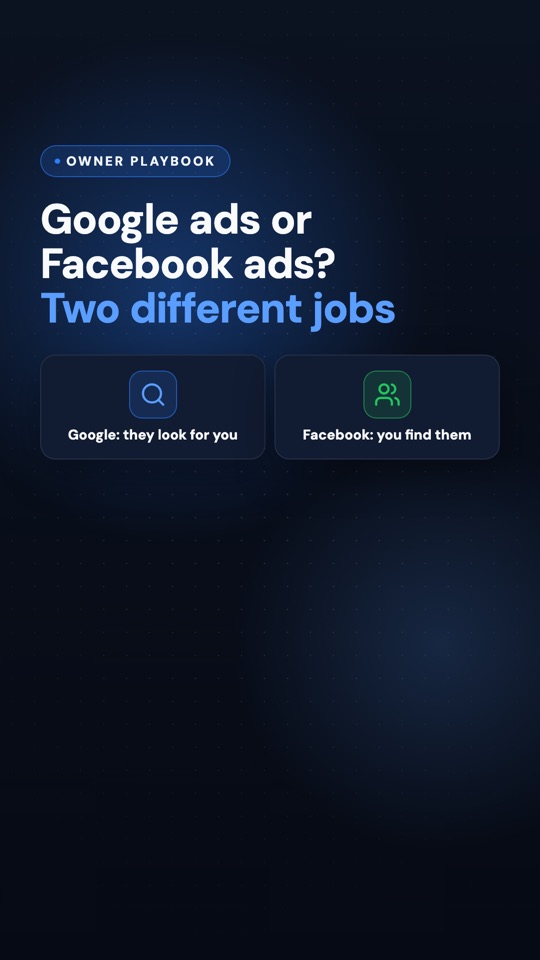
Google Ads and Facebook Ads do two different jobs for a laundromat. Google search ads catch people who need a laundromat right now. Facebook and Instagram ads reach neighbors who don't know you yet. Google catches demand. Facebook creates it.
Most stores do best running both. If your budget only stretches to one for now, start where your gap is. Here's what each one is for, who it reaches, what to measure, and how to choose.
Prefer to watch? Here's the 39-second version.
Google Ads vs Facebook Ads for laundromats: which does what?
We post a short laundromat marketing tip every Tuesday and Thursday on Instagram, Facebook and YouTube.
Watch it on Instagram →·Follow @freshleadsmarketingGoogle catches demand
When someone types "laundromat near me" into Google, they need a laundromat today. Their washer just died, they moved last week, or they're holding a king comforter that won't fit in the machine at home. They're not browsing. They're choosing.
A Google search ad puts your store at the top of that search, at the exact moment they're choosing. It can say what matters to them, like "Spin City Laundry | Open Till 10 PM. Big washers for comforters. Clean, bright, attended daily," and offer a way to call or get directions.
The strength is timing: everyone who sees the ad already wants what you sell. The limit is volume. Google can only show your ad to people who search, so when nobody's searching, there's nobody to reach, however much you're willing to spend.
One more thing: an ad gets you in front of the searcher, but your listing, reviews and photos still do the convincing. If you haven't checked those lately, start with the five reasons laundromats go missing on Google Maps. They're free to fix, and they're what a searcher checks before driving over.
Facebook and Instagram create demand
Facebook and Instagram ads work the other way around. You're not waiting for anyone to search. You're reaching people within a few miles of your store while they scroll, before they've thought about laundry at all.
Think of the new neighbors who just moved into the apartments down the street and haven't picked a laundromat yet. Or the family that washes at home and has no idea your big washers could do their comforters in one load. None of them is searching for you. Plenty of them would be glad to know you're there.
Because they aren't looking, the ad has to give them a reason to stop: a clear picture and a simple offer. Something like "Free dry with a wash. New to the neighborhood? Say hi to your closest laundromat."
You choose the area. Usually it's a few miles around the store, since people tend to pick a laundromat close to home. Geo-fencing narrows it further, to specific places such as nearby apartment complexes or a competitor's parking lot. Our guides to geo-fencing strategies and fencing around your competitors go deeper, and it's something our team runs for clients as part of geo-fencing ads.
The limit here is patience. Someone who sees your ad on Tuesday may not need a laundromat until Saturday. Facebook plants the name. The visit can come later.
Who each one reaches
- Google: people searching right now, who need a laundromat today. You reach only as many as search.
- Facebook and Instagram: people near your store who aren't looking for you yet. They hear about you first, and remember you when the need comes.
That's why they work well together. A neighbor sees your Facebook ad in the morning and scrolls past. Saturday, their washer breaks, they search "laundromat near me," and your name is the one that looks familiar.
What to measure (hint: not clicks)
Ad reports are full of impressions and clicks. Neither one does a load of laundry. Measure what happens after the click instead:
- From Google: calls from the ad, direction requests, and new faces in your POS.
- From Facebook and Instagram: offers claimed, messages to the store, and offers actually used at the counter.
- From both: new customers showing up in your POS, like new cards or new accounts, in the weeks the ads run.
🏷️ Make each ad easy to track
Give each platform its own offer, or at least its own way to redeem it: one thing to show at the counter for the Facebook offer, a "mention this ad" line on Google. Then when someone new walks in, you know which ad sent them. An offer nobody can trace is an offer you can't judge.
Small budget? Start where the gap is
If you can only run one for now, pick the one that fixes your biggest problem.
Start with Google if:
- People searching "laundromat near me" can't find you.
- Competitors show up above you when you search from your own parking lot.
Start with Facebook and Instagram if:
- Your neighbors don't know you exist: you're new, under new ownership, or just renovated.
- You have something new to announce, like bigger machines, wash and fold, or a new offer.
Take two made-up stores. Bluebird Laundromat has been busy for years, but a new store opened a mile away, and now it shows up above Bluebird on Google. That's a search gap, so the owner, Priya S., starts with Google search ads and watches calls and direction requests.
Across town, Northgate Wash just reopened after a remodel with new big washers, and hardly anyone nearby knows. That's an awareness gap, so its owner starts with Facebook and Instagram ads a few miles around the store, with a comforter offer, and counts how many people use it at the counter. Once each store has its first channel working, adding the other is the natural next step.
Mistakes to avoid
- Judging either one by clicks. Calls, directions and new customers are the numbers that pay the rent.
- Running Facebook ads with no offer. A photo of your storefront and "Come visit!" gives a scroller no reason to stop.
- Sending Google traffic to a weak listing. Wrong hours and old photos lose the customer you just paid to reach.
- Targeting the whole city. Pay for the neighborhoods your customers actually come from.
- Calling Facebook a failure after a week. Its job is to plant your name before people need you. Give it time to do that.
- Expecting one to do the other's job. Google can't reach people who aren't searching, and Facebook can't catch the person searching right now.
The takeaway
Google catches demand. Facebook creates it. Ideally, you run both, because one reaches people who need you today and the other makes sure more people know you exist before they do.
If you're starting with one, pick it by your gap, not by which one a friend swears by. Then measure calls, directions and new customers, not clicks, so you know whether it's working.