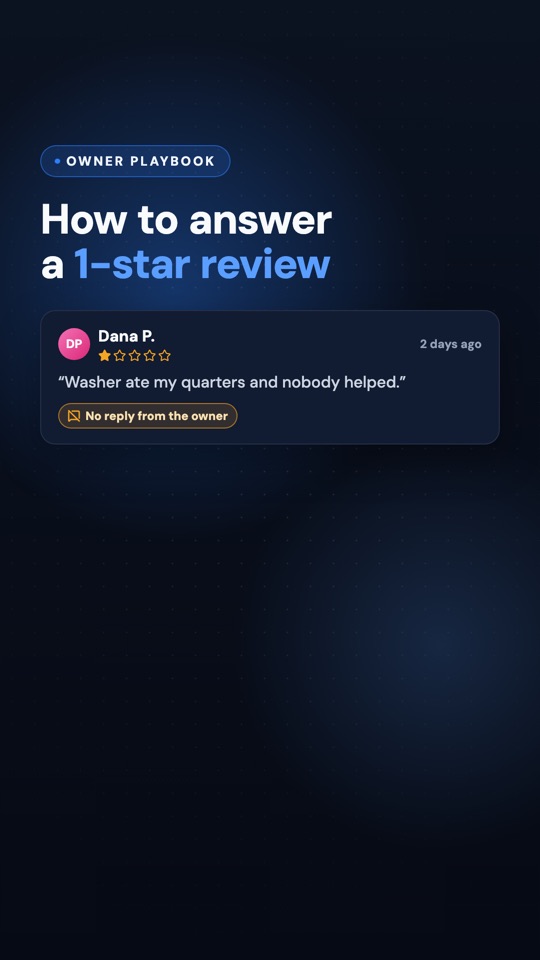
To answer a 1-star review at your laundromat, reply within a day or two in four short steps: thank them for telling you, apologize with no excuses, say what you fixed, and take the rest of the conversation offline with a name and a way to reach you.
The reply isn't really for the person who wrote the review. It's for every future customer who reads it while deciding where to wash this week. Here's how to write one that makes them trust you more, not less.
Coming Thursday, Oct 8 to Instagram, Facebook and YouTube
How to reply to a 1-star review (for laundromat owners)
We post a short laundromat marketing tip every Tuesday and Thursday on Instagram, Facebook and YouTube.
Follow so you catch it →Who your reply is really for
When a 1-star review lands, it feels like a conversation between you and one angry customer. It isn't. That customer may or may not come back, whatever you write. But the review will sit on your listing for years, and everyone comparing you to the store down the street will read it, and your answer, before they decide.
Those readers aren't asking whether your store is perfect. They know washers break. They're asking a simpler question: if something goes wrong there, will anybody care? A calm, specific reply answers yes. A defensive one, or no reply at all, answers no.
Done well, a bad review can end up as proof that someone is minding the store.
The 4-step reply
- Thank them for telling you. It feels backwards, but a thank-you lowers the temperature before you say anything else. Plenty of unhappy customers leave without a word. This one told you what to fix.
- Apologize, with no excuses. Say you're sorry for their experience. Explaining why it wasn't your fault reads as arguing, even when it's true.
- Say what you fixed. Name it: the machine was repaired, the sign was updated, the attendant was trained. If it isn't fixed yet, say what you're doing about it, and only claim what's true.
- Take it offline. Give a name and a way to reach you. The rest of the conversation happens in private.
Then keep it short, a few sentences, and post it within a day or two. A reply that shows up a month later tells readers the same thing as no reply.
📋 Copy this reply
Hi Dana, thank you for telling us. I'm sorry the washer took your quarters. We had it repaired this week. Please call me at the store so I can make it right. Maria, owner
A worked example: the dryer that never got hot
Here's how the four steps play out at a made-up store, Elm Street Wash House. The owner, Angela, wakes up to this:
"Dryer 12 took my money and never got hot. My clothes came out soaking wet and nobody was there to help. Never again." 1 star, Marcus T.
Her first draft says the dryer was fine when she checked it and that there's a phone number on the wall. Both might be true. Neither helps, because both are arguments. Here's what she posts instead:
"Hi Marcus, thank you for letting us know. I'm sorry dryer 12 took your money and left you with wet clothes, and that nobody was there to help. We replaced the heating part on Monday and tested it that afternoon. Please call me at the store at 555-0142 so I can make this right. Angela, owner"
Every sentence has a job. The thank-you cools things down. The apology repeats his problem back in his words, so he knows she read it. The fix is specific enough to believe. The phone number and her name move the rest offline. And a stranger reading it learns that the owner answers, fixes things, and signs her name.
If Marcus calls and Angela refunds him, good. That's making it right. What she can't do is tie the refund to the review.
What never to write
- Don't argue or blame them. "Maybe read the instructions next time" might feel earned. To everyone else, it's a fight, and you're the business.
- Don't share their details. No last names, no visit times from your cameras, no "you only come once a month anyway." Even if your POS shows exactly what happened, a public reply is the wrong place for it.
- Don't offer anything to change or remove the review. No free wash, no refund, nothing on the condition that they edit or delete it. That's against Google's policy. Fixing the problem privately is fine, as long as it doesn't depend on the review.
- Don't paste the same reply everywhere. Readers notice a copy-and-paste apology, and it sounds like nobody read the review.
- Don't reply angry. Wait an hour. Your reply is public and stays up as long as the review does.
- Don't promise what you can't keep. "This will never happen again" isn't believable. "We replaced the part and tested it" is.
When the review is fake or breaks the rules
Sometimes the review isn't from a customer at all. It's spam, it describes a different business, it's full of hateful language, or it comes from someone with an obvious grudge who has never been in your store.
You can flag a review like that for Google to look at. Open your Business Profile, find the review, and report it as breaking Google's policies. Google decides what happens next. It may take the review down, and it may not, so don't count on it, and never pay anyone who promises a removal.
While you wait, reply anyway, calmly: "We don't recognize this visit, and we'd like to understand what happened. Please call me at the store." Readers see a reasonable owner either way.
⚖️ Unfair isn't the same as fake
A real customer's honest 1-star review is allowed, even if you think it's harsh or they got the facts a little wrong. Flag reviews that break the rules. Answer the ones that simply sting.
Reply to the good ones too
Your good reviews deserve an answer as well. A short thank-you that uses their first name and mentions something they said is plenty: "Thanks, Keisha! Glad the big washers handled that comforter." It shows the next reader that a real person is on the other end, every time, not only when there's a fire to put out.
A listing full of old reviews with no replies is one of the five reasons laundromats go missing on Google Maps. And the more good reviews you have, the less any single bad one stands out, which is one reason reviews can matter as much as your ad budget. Keep them coming by asking every customer, not only the happy-looking ones, and never offering anything in return. If keeping up feels like a second job, review requests and replies are part of what we handle for our clients.
What to do this week
Open your reviews and find every one without a reply. Start with the most recent negative review and answer it with the four steps: thank, apologize, say what you fixed, take it offline. Then thank the last few people who left good ones.
Save the template somewhere you'll find it, like your phone's notes. The next time a 1-star review lands, you'll already know what to write.